The Feriköy Protestant Cemetery: A Quiet European Necropolis in the Heart of Istanbul
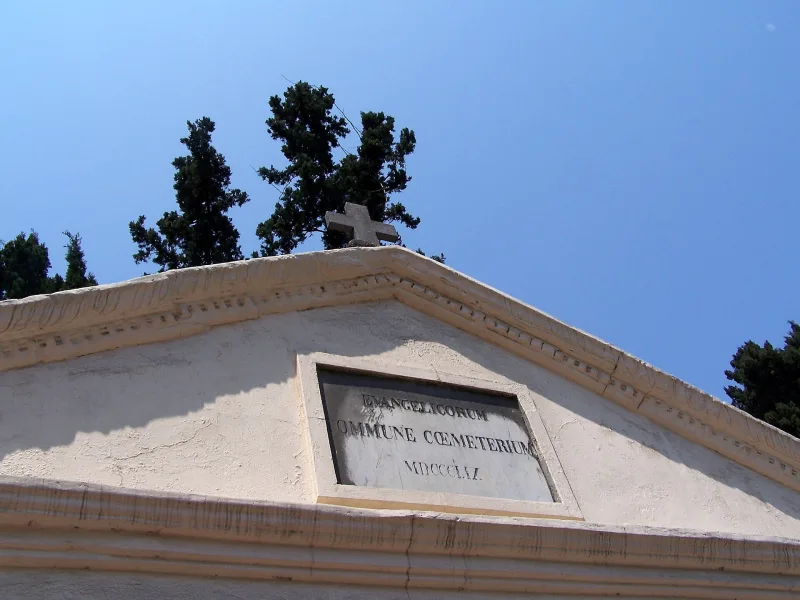
The Feriköy Protestant Cemetery is an unusual corner of Istanbul, where British diplomats, Prussian musicians, Swiss brewers, American missionaries, and German scholars rest side by side in the shade of cypresses and old plane trees. Its official Latin name is Evangelicorum Commune Coemeterium, “General Evangelical Cemetery.” It is located in the Feriçe neighborhood of the Şişli district, about three kilometers north of Taksim Square, and is an official member of the Association of Significant Cemeteries of Europe (ASCE). The Feriköy Protestant Cemetery has welcomed visitors since 1859 and serves as a unique open-air museum of funerary sculpture: it houses monuments dating from the 17th century to the present day, and a total of about five thousand people are buried there.
History and Origins of the Feriköy Protestant Cemetery
The history of this place begins long before the first coffin was brought to Feriköy. Until the mid-19th century, all Europeans in Constantinople were buried in a vast necropolis beyond Pera, which was given the romantic name Grand Champs des Morts—“Great Fields of the Dead.” This “city of the dead” stretched northward from what is now Taksim Square and was so well-known in Europe that it inspired cemetery reformers from Paris to Vienna. The Frankish, or Western European, section had the most recognizable atmosphere: cypress trees, marble steles inscribed in Latin, and crosses of various denominations.
But Istanbul’s rapid growth worked against the old necropolis. From 1840 to 1910, the area between Taksim and Şişli transformed from open fields and gardens into dense residential development. The “Great Fields of the Dead” found themselves directly in the path of the expanding city. As early as 1842, the American missionary William Goodell bitterly described how he had to bury the body of his nine-year-old son, Constantine Washington, who had died of typhoid fever: “The grave was dug deep, and the coffin had barely dried out. Everything was quiet and peaceful… Farewell, beloved child!”
In 1857, by decree of Sultan Abdul-Mejid I, the Ottoman government granted land in Feriköy to the leading Protestant powers of the era: Great Britain, Prussia, the United States, the Netherlands, Sweden, Norway, Denmark, the Hanseatic cities, and the Grand Duchy of Oldenburg. The first burial took place in November 1858, and the cemetery officially opened in early 1859. In July 1863, the remains of more than a dozen Americans, including little Constantine Goodell, were exhumed from the old Frankish section and transferred to Feriköy along with their headstones. The former “Great Fields of the Dead” were turned into a public park—in 1869, Taksim Garden opened here, on the site of which the square of the same name is located today.
Architecture and What to See
At first glance, the Feriçe Protestant Cemetery looks like a peaceful green square behind a high stone wall. But once you pass through the main gate, you find yourself in a space where every square meter tells a separate story. The grounds were laid out according to mid-19th-century Western European models: smooth gravel paths, neat sections, and low hedges of boxwood and laurel. Cypresses and plane trees cast dense shade even at midday in August, while blooming lilacs, wisteria, and roses soften the solemnity of the white marble.
Monument Row: a parade of funerary sculpture
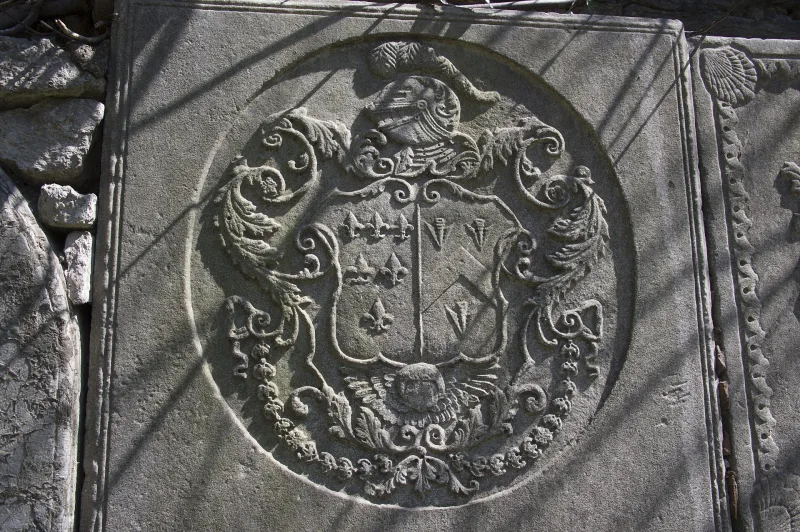
The main attraction is the eastern wall, along which stretches the so-called Monument Row. Over time, the most striking tombstones from the old Frankish cemetery were moved here and arranged in a row, like exhibits in an open-air museum. Here you can see 17th-century Baroque cartouches, Classicist urns, Gothic pointed arches, Romantic-style angels, and modest 20th-century Modernist steles. For a Russian-speaking traveler, this is reminiscent of a walk through the Smolensk Lutheran or Volkov Cemeteries in St. Petersburg: the same silence, the same fine gravel underfoot, the same mix of European surnames, and the Eastern sky overhead.
Armenian Protestant Section
In the southwest corner is a separate section for Armenian Protestants. It is separated from the main section by a low wall—once this distinction was fundamental: Armenians were considered Ottoman subjects, and burying them alongside foreigners would have been a violation of imperial rules. Today, this distinction remains as part of historical memory. This same section also contains the tombstones of Greeks, Arabs, Assyrians, and Turkish Protestants themselves, including former Muslims who converted to Christianity. The epitaphs are carved in a dozen languages: Armenian, Greek, Arabic, Syriac, English, German, and Ottoman Turkish written in Arabic script.
Commonwealth War Memorial
In the central part, there is a single Commonwealth war grave: here lies a British intelligence officer who died in 1945, during the final months of World War II. A white standard slab with a cross and an inscription, typical of all Commonwealth War Graves Commission cemeteries, stands out against the backdrop of the diverse private monuments.
Monument styles—from Baroque to Modernism
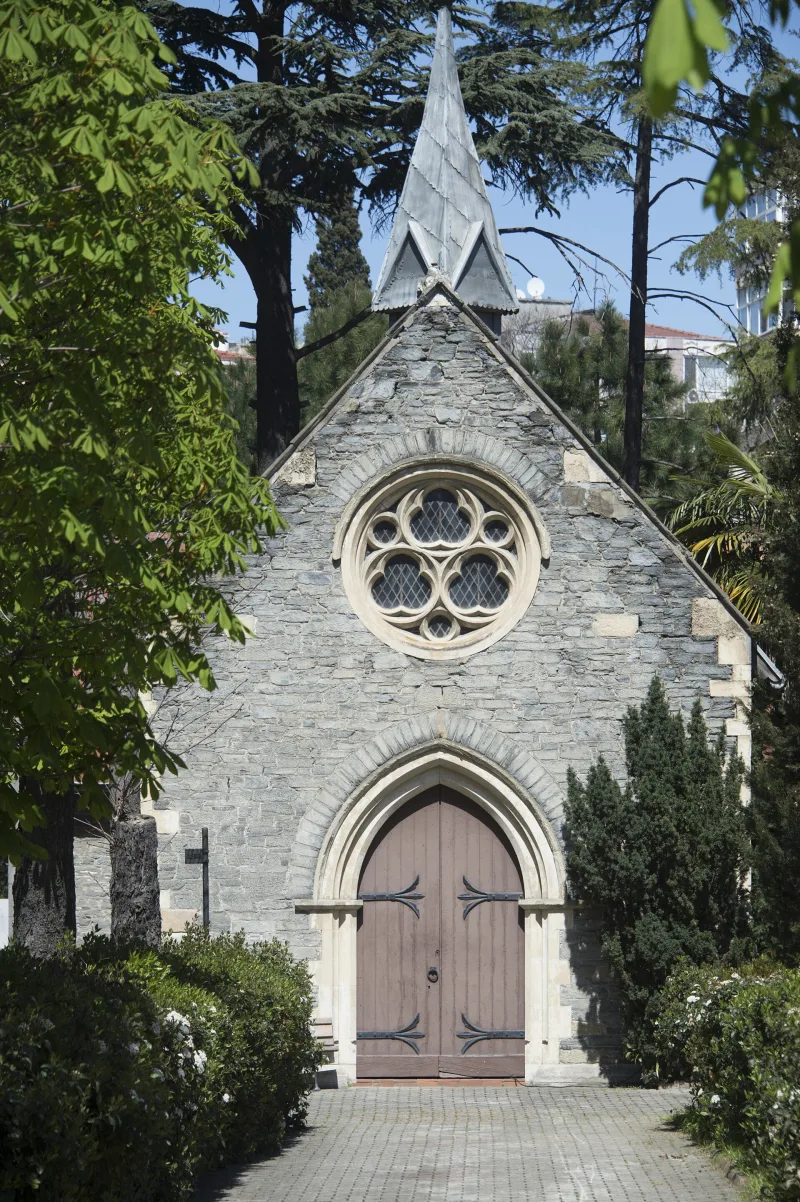
The cemetery showcases virtually every trend in modern European memorial architecture. Neo-Gothic family chapels and mausoleums stand alongside austere crosses on low pedestals. There are life-size statues of angels, weeping muses, open marble books with epitaphs, and symbolic columns broken in the middle—a symbol of untimely death popular in the 19th century. The tombstones of the Levantine families—the Beaumonts, Fruchtermans, and Langs—whose role in the business and cultural life of 19th- and 20th-century Istanbul was immense, are particularly worth seeing. Many epitaphs are written in the form of short poems or biblical quotations; inscriptions in seven or eight languages can be found side by side on a single slab—English, German, Dutch, French, Swedish, Hungarian, Latin, and Greek.
Preservation Initiative and the Cemetery’s New Life
In 2018, local residents and descendants of those buried there founded the Feriköy Protestant Cemetery Initiative—a volunteer organization dedicated to preserving the cemetery as a place of remembrance, a historical landscape, and an urban green space. In 2021, the boards of seven consulates general officially recognized the Initiative as their partner. Since then, guided tours have been held here, gravestones have been restored, and a newsletter featuring stories about individual graves has been published. For travelers, this means that the site isn’t just “open during the day” but is truly alive: you’ll find signs with QR codes, gardeners tending to the hedges, and on weekdays, you can even join a small group walk led by a volunteer historian.
Interesting facts and legends
- Franz Karl Beaumonty (1857–1903) is buried here—a Swiss brewer who was at the forefront of the modern Turkish brewing industry. It is his surname that appears in the name of the Beaumonty neighborhood and the eponymous beer brand, familiar to many who have walked through Beyoğlu.
- Among the graves is the tombstone of Paul Lange (1857–1919), a Prussian musician and the last court conductor of the Ottoman Empire. He led orchestras and choirs in Istanbul for nearly forty years and, according to the recollections of his contemporaries, even conducted during World War I, when both German and Turkish officers were seated in the hall.
- Betty Karp (1895–1974)—an employee of the American Embassy and an intelligence officer—as well as British historian Norman Stone (1941–2019), known for his books on the history of World War I and Eastern Europe, who taught for many years at Istanbul’s Bilkent University.
- Also buried here is Elias Riggs (1810–1901), an American missionary and linguist who worked on translating the Bible into Bulgarian and Armenian—his works are still used in worship services today.
- One of the most touching stories is connected with the name of Constantine Washington Goodell: the boy was buried twice and moved once, and it is his reburial in 1863 that is considered the symbolic beginning of the cemetery’s new life—the relocation of old European memories to a new place.
- Among those buried there is Ernest Mamburi (1878–1953), a Swiss Byzantinist and author of the classic guidebook “Constantinople: Guide Touristique,” as well as Hilary Sumner-Boyd and John Freely, co-authors of the famous “Strolling through Istanbul”—without exaggeration, the most cited city guide in English.
How to get there
The Feriköy Protestant Cemetery is located in the Şişli district, about 3 kilometers north of Taksim Square. The most convenient way to get there is by the M2 metro line (green line). Take the metro from Yenikapı or Taksim to the Osmanbey or Şişli-Mecidiyeköy station, exiting via the Feriköy neighborhood. From both stations, it’s a 10–15-minute walk to the cemetery gates through the streets of the residential neighborhood; you can use a navigation app with the coordinates 41.0539, 28.9839. The route from the metro passes by the Feriköy Bazaar and several late 19th-century Levantine apartment buildings—the journey itself becomes part of the experience.
From Istanbul Airport (IST), the most convenient way is to take the M11 metro to Kağıthane station, transfer to the M7, and continue to Mecidiyeköy—about an hour with luggage. From Sabiha Gökçen Airport (SAW), it’s faster to take the Havabus to Taksim and from there, one or two stops on the M2 metro. If you’re taking a taxi, tell the driver “Feriköy Protestant Cemetery” or “Şişli Protestant Cemetery”—Turkish taxi drivers usually know both names. Nearby, across the street, is the Pangaltı Catholic Cemetery, which you can visit at the same time. In good weather, you can walk from Taksim in about 35–45 minutes: the route goes up Halaskargazi Street, passes by the Armenian Church of Surb Astvatsatsin, and descends to Feriköy—one of the most atmospheric walks through old Pera.
Tips for travelers
The best time to visit is spring (April–May), when the lilacs and wisteria are in bloom, and fall (September–October) with its soft golden light. In summer, Şişli is hot and crowded, but it’s always cooler under the cypress trees; in winter, the cemetery is open, though the paths can be slippery after rain. Allow 60–90 minutes for the walk, or up to two hours if you’re interested in epitaphs and monument styles.
Dress respectfully: long pants or a skirt, covered shoulders. This is not a religious requirement but a rule of decorum for an active cemetery. Photography is allowed and encouraged, but avoid taking pictures of families visiting graves, and do not climb onto the pedestals for a better angle—many 19th-century monuments are fragile. Hours of operation may vary; before your visit, check the Feriköy Protestant Cemetery Initiative website or call one of the consulates general on the board (Germany, the UK, the US, the Netherlands, Sweden, Hungary, Switzerland)—the chairmanship rotates annually.
Combine your walk with a tour of nearby sites: the Pangalta Catholic Cemetery across the street, the Feriköy neighborhood with its antique shops and Sunday flea market, and Beyoğlu with its former brewery-loft and restaurants. You can walk down to Taksim in 40 minutes—the route takes you along Halaskargazi Street, one of the most atmospheric thoroughfares of old Pera. For Russian-speaking tourists tired of noisy bazaars and crowded mosques, the Feriçe Protestant Cemetery offers a rare opportunity to experience that “other” Turkey: cosmopolitan, Levantine, multilingual, where Europeans and Ottomans coexisted under the same sky for centuries, and where the memory of this coexistence can still be read on the old marble slabs.